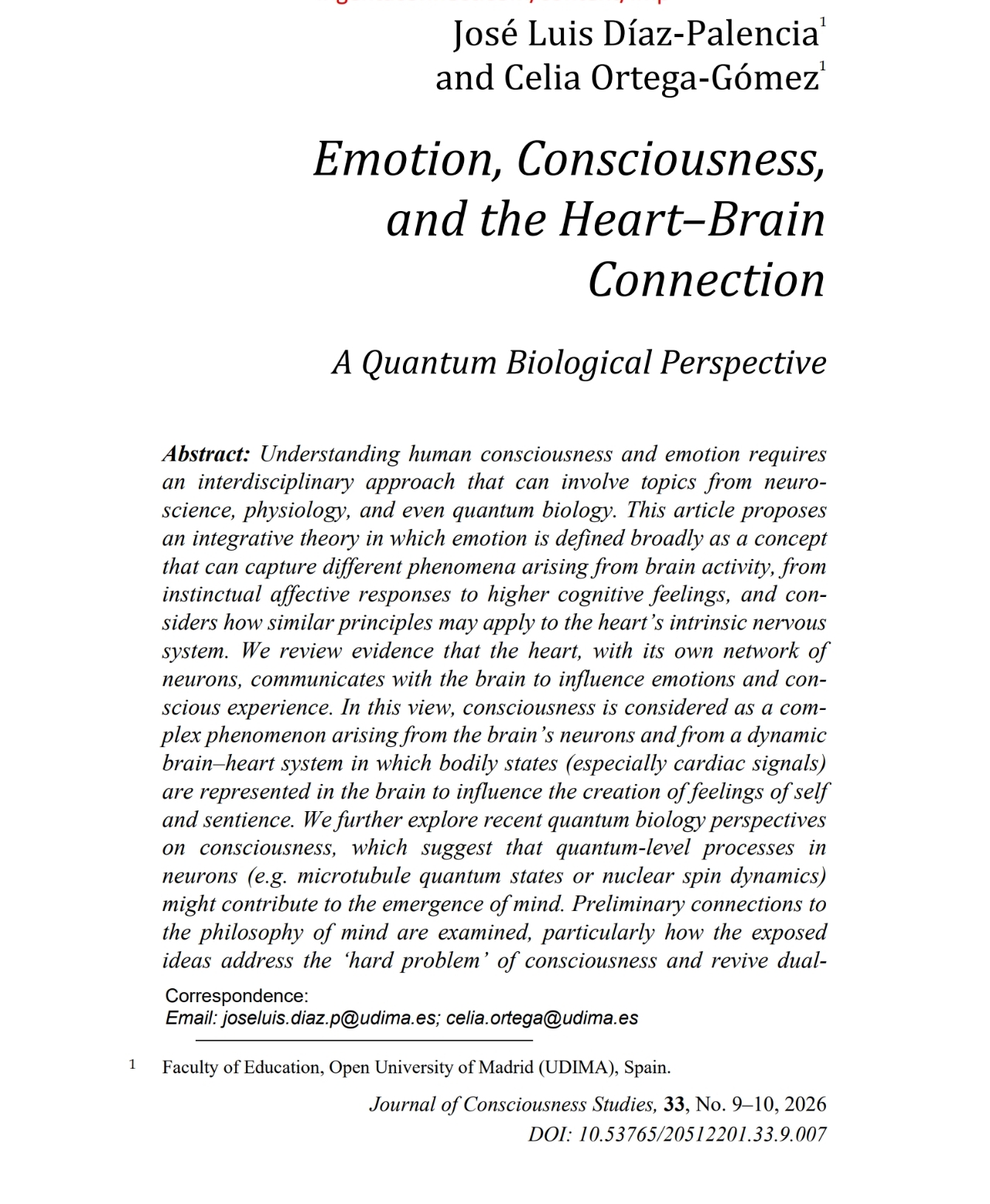
| dc.description.abstract | Understanding human consciousness and emotion requires an interdisciplinary approach that can involve topics from neuroscience, physiology, and even quantum biology. This article proposes an integrative theory in which emotion is defined broadly as a concept that can capture different phenomena arising from brain activity, from instinctual affective responses to higher cognitive feelings, and considers how similar principles may apply to the heart’s intrinsic nervous system. We review evidence that the heart, with its own network of neurons, communicates with the brain to influence emotions and conscious experience. In this view, consciousness is considered as a complex phenomenon arising from the brain’s neurons and from a dynamic brain-heart system in which bodily states (especially cardiac signals) are represented in the brain to influence the creation of feelings of self and sentience. We further explore recent quantum biology perspectives on consciousness, which suggest that quantum-level processes in neurons (e.g. microtubule quantum states or nuclear spin dynamics) might contribute to the emergence of mind. Preliminary connections to the philosophy of mind are examined, particularly how the exposed ideas address the “hard problem” of consciousness and revive dual-aspect and panpsychist interpretations. We discuss how heart-brain interactions and quantum processes together might provide new connections with conscious experience – including the age-old intuition of the “heart” as an organ of wisdom and emotion. | es |